 Login Schedule demo Login Schedule demo
 Wondering what communication channels your company should be prioritizing to better inform employees? Read this complete guide to learn more.


With the ever-changing landscape of the workplace, implementing the right communication channels will be crucial to keeping employees happy, connected, informed, engaged, and productive.
And it should be no surprise, employees want consistent information and transparency into the business. For example, 85% of employees said they’re most motivated when management offers regular updates on company news.
But even as remote work and the digital workplace become more apparent, organizations often still struggle with their communication strategies and knowing how to best distribute news. So how can you best improve your communication channels and ensure employees feel valued?
In this guide, you’ll learn the following:
The use of communication channels in the workplace is how people throughout the company stay informed, communicate, and interact with each other on a regular basis. Without these channels, it becomes difficult to keep employee morale high and ensure everyone understands the business goals.
And today more than ever, communications is the glue that ensures everyone has the best experience possible at work and continues to grow professionally.
The world of work has continued to change via the rise of mobile, remote work, as well as organizations with global locations and frontline employees — your communications must reach people where they are and when they work.
Before getting into the top communication channels to utilize, you can actually break these down into a few different categories. There will be situations where you have messages that will probably fit into every category at some point or those that may blur the lines.
And each of these categories can be done through digital communication channels, written communications, or in-person (face-to-face).
And each of these categories can be done through digital communication channels, written communications, or in-person (face-to-face).
Ensuring your organization is communicating correctly and employees are receiving the right messages is critical to business success. The positive impact can be felt in numerous ways like:
Wondering what’s going on in the world of communications? Here are some important stats that might surprise you or help you understand the value further.
Looking for more? Check out more internal communication statistics here in this post.
Today, most organizations are utilizing digital communication channels in order to reach and engage employees. It’s the most direct and efficient way to connect with everyone in real-time, no matter where or when they are working.
Here are the common communication channels:
Even in the early days of technology and the internet, the intranet became the go-to means to connect with employees internally. It’s a way for employees to be informed about their company and access important documents.
The challenge with intranets is that they tend to be outdated and can make finding information a bit more challenging. In a survey by Prescient Digital Media, only 13% of employees reported participating in their intranet daily—31% said they never do.
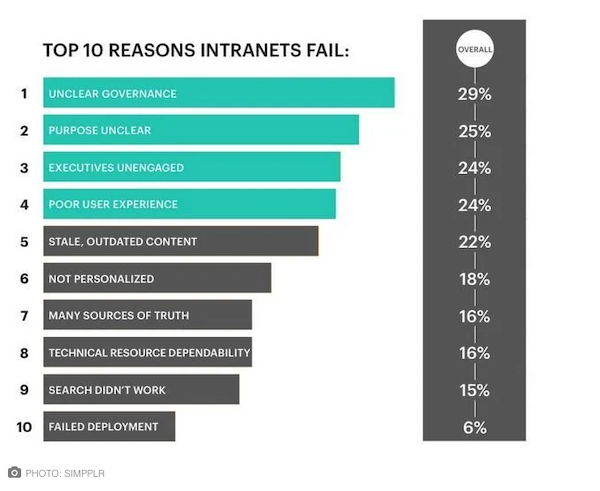
Implementing an intranet lacks purpose, serving relevant content, and outdated design that people find clunky.
According to CMSWire, 90% of intranets fail and are still failing. It’s why an intranet alternative can be a good solution.
Another classic communication channel is email and it’s not going away anytime soon. And for some organizations, email tends to be the top channel for internal communications. The problem is for company information: is it the best means to distribute information?
Many companies (yours included) might have a company-wide newsletter. The goal is to include important company information, blog posts, and maybe encourage some form of employee advocacy.
The challenge is that information is not tailored to individual groups and can cause employees to ignore these emails. 62% of the emails received by employees are not important, and 83% of employees report feeling burnt out by a high volume of emails.
And inboxes continue to fill up, where these newsletters get buried and important time-sensitive items can be completely missed. Although emails can still be necessary, they should be an add-on to a more modern communications approach.
The concept of instant messaging software has been around for a while. any of you might remember the glory days of AOL instant messenger. But the quickness of messaging and sharing information made this important for businesses.
And when Slack came along, most organizations started adopting some service to connect with employees.
What makes this communication channel work is the ability to create instant team discussions, ask quick questions, and have private discussions with individuals.
However, the increase of technologies and platforms has also created a distracting workplace. There have been articles about why messaging software or tools like Slack can cause distractions. The other challenge is while you can make a channel where everyone has access, these real-time messages move quickly and can be lost.
Often, you might not think of a project management tool as one of the top communication channels, but it’s where collaboration and productivity happen. Plus, many of the well-known tools have commenting and communication features to discuss tasks.
These tools allow employees to create tasks and projects with a few clicks. And these platforms create calendar views and task scheduling to ensure projects are completed in a timely manner.
And while these tools make communications on projects go more smoothly, this small digital channel is not enough to handle all your communications needs. So keep in mind that project management tools will not be sufficient to reach every employee with the content and news they need.
Video meeting software has been on the radar as a strong channel for communications, but it ramped up with remote work and during the pandemic of 2020. It makes more personal interactions available, even when you are working in a completely different timezone.
Video software allows you to see people face-to-face and distribute information quickly. Plus, you get to know the people who work with you more effectively.
This form of communication works well for small teams or 1-on-1 conversations but can be a challenge for company-wide initiatives. Video conferencing solutions are not ideal for driving ongoing company conversations, for sharing updates and getting feedback, or getting better employee engagement.
But it should be in your communications tech stack.
One of the budding and expanding digital communication channels is the idea of internal social networking. The goal of this channel is to quickly share, connect, and reach employees — but to also allow individuals to engage and connect with each other.
That’s what an employee advocacy platform brings to the organization. But it also allows individuals to create and share content to their own networks, boosting external communications, as well.
When you utilize internal social media your company improves collaboration, community, knowledge sharing, and communication between anyone within your organization.
Related: Learn how Cloudera uses internal social media to drive marketing and sales, but also to improve communications and employee engagement among their distributed teams. Read the customer story!
You might not think about internal surveys too often as a communications channel, but it’s powerful because it helps your company understand how employees consume information.
But not just that, it can give you insights into managers, company culture, the employee experience, and much more.
By using employee survey software you’ll be able to gather data that can guide your internal communications strategy for the better.
And though there are limitations with being an open communication channel, it is powerful in better understanding what your employees think and feel about company processes.
Not having a good database of documents with ease of search and organization also causes communication bottlenecks. That’s where document sharing solutions also become pivotal as a digital communications channel for employees.
These tools easily organize important documents and keep detailed records of information. These can be pretty sophisticated or something as simple as Google Drive. However, you still need a strategy and means to ensure finding the information is simple.
Document sharing platforms are not necessarily designed to help you share specific information with employees when they need it most. So building groups, segments, and still managing the distribution of files is critical.
86% of employees say that they usually experience difficulty searching for office files when they need them.
Besides internal social media, many organizations have started exploring blog content directly tailored to their employees.
Typically, enterprise companies have taken on this task as the fast way to share information, company values, and news about the business out to the world. Generally, the public may have access to this content too, where others may only make it an internal blog.
The problem is that the content needs to still be on employees’ radar. Even if they know a company blog exists, they may not be dedicating time to seek it out, or they’ve completely forgotten about it. Every employee is different - some will love reading the blog, and others will wait for you to send them the relevant information.
The good news is a platform like EveryoneSocial can pull in these RSS feeds automatically that will show in employees’ feeds and can be sent email reminders about the content.
Hopefully, you are getting a deep understanding of how critical communication channels are to your company and employees! There are lots of channels to think about and how to best communicate with your teams.
But if you are choosing the wrong channels or too many at once, you can hurt the employee experience, productivity, and disrupt collaboration among employees. But it can extend beyond that. Here are some common consequences of picking the wrong internal channels.
As you can see, choosing the wrong channels and providing too much information can also negatively hurt your organization. And when your communications are broken, it can trickle into all other areas of the business.
Every organization is different and all employees are unique in how and when they consume information. So this presents a bit of a challenge for your organization as too few and too many channels can ruin your internal communication flow.
How can you ensure that you are choosing the right communication channels at work? Here are a few tips to help you navigate or adjust your current strategy.
A great way to understand what communication distribution channels you’ll be using is to determine the types of messages that employees will receive. That way, you can determine the right channels to push that message to.
Although every company should be transparent and open to communications, some are more guarded than others. The challenge is the data shows how a lack of good culture around communications can impact the business in a negative way.
But to distribute messages appropriately means you need to understand the culture surrounding internal communications.
For example, if remote work and digital platforms are the way to go, then utilizing things like email, instant messaging, and employee advocacy platforms will work well to get company info across the organization.
Another example is if your company values a good work/life balance, then sending emails or text messages at night is not the way to go.
It’s unavoidable that there will always be multiple channels for you to share information and content. There are certainly opportunities to consolidate (see more in the next section), but there will inevitably be various channels to select.
One way to ensure the right channel is to understand the audience of the message or info you are sending. How quickly does this information need to be addressed and how does this particular audience interact on certain channels?
Certainly, if you work for a large or enterprise business, you won’t know everyones’ preferences, but you can reduce friction by getting to know the channels better. Should your message be in-person, voice and video, or written? Which technologies can these be accomplished with?
The way companies connect with their teams and the channels that can be used has certainly grown in recent years. Mostly due to the digital workplace and how people work today.
Even with all this information and knowledge about internal communications, it can still be a struggle figuring out how to reach everyone — from the intern to the CEO — with the right information and content.
Think about all the ways communications are distributed today at organizations: company newsletters, emails from managers and employees, survey apps, instant messaging software (I.E. Slack), intranets, document sharing platforms, text messaging, video conferencing, etc.
All these ways to communicate can play a pivotal role, but it’s important to find the balance and also look to combine channels into a more centralized option.
A more modern approach to the intranet and a way to consolidate channels is to useEveryoneSocial.
Traditionally, employee advocacy platforms were a strong marketing and sales channel. And while that still holds true today, communications has become the cornerstone of the EveryoneSocial platform when we rebuilt our product.
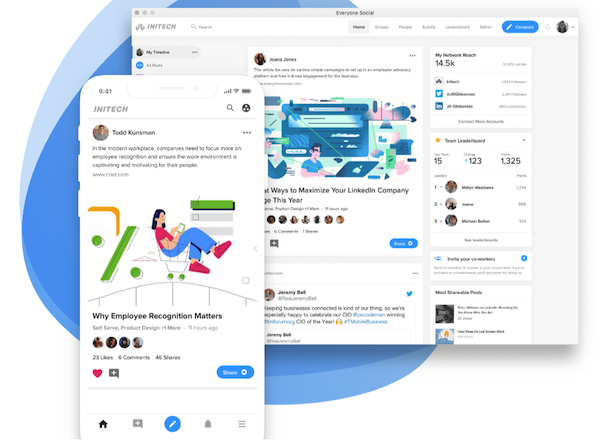
Now your company can distribute content, newsletters, email and push notifications, company messages, and more important information directly from one feed to employees. Employees can access these messages when it is convenient for them and from their preferred device!
In our employee feedback report where we survey all our customers, two data points stuck out:
Of course, this does not cover everything about EveryoneSocial and the power of employee advocacy at your company. But it should give you the big picture.
Todd served as Director of Marketing at EveryoneSocial, leading content strategy and editorial across the blog through 2021. Today he is Head of Content & Brand at RemoFirst, founder of Linkeezy (an inbox and content tool for LinkedIn), and a SaaS marketing and content advisor.
See the platform that comms, marketing, and compliance teams use to run their advocacy program.